Secure Shredding Levels Explained: Which Security Level Does Your Business Actually Need?
Finding the sweet spot between shredder performance metrics like speed and capacity is an age-old dispute in the document destruction industry. Businesses in South Africa are focusing on finding shredding solutions that meet modern standards, and one important consideration is the trade-off between capacity and speed. Delving into the complexities of this trade-off, this article examines the elements that impact the performance of shredders and the technological advancements that will shape the shredding industry in South Africa in the year 2024.
We offer secure off-site shredding and convenient mobile shredding services to suit your business needs.
Why document shredding security is more important than many businesses think
Many businesses assume that once a document has gone through a shredder, the information on it is no longer a concern.
This way of thinking creates unnecessary compliance and data security risks.
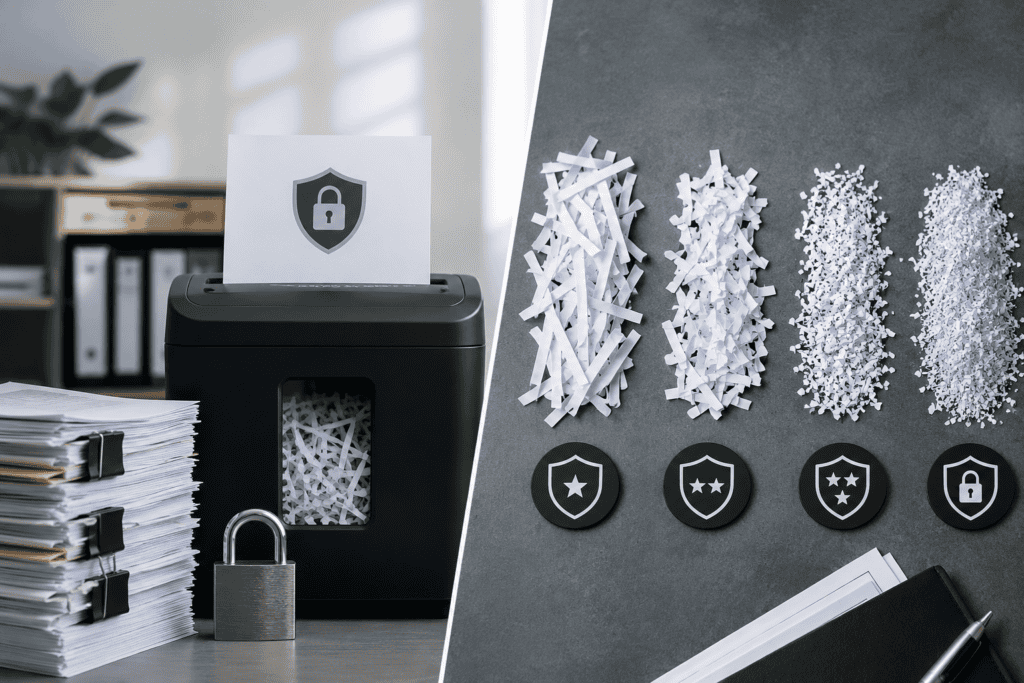
Not all shredders destroy documents in the same way. Some only cut paper into long strips which can still be pieced together, while others reduce sensitive information into tiny particles that are extremely difficult to reconstruct.
For businesses handling client records, employee information, financial statements, medical files, legal documentation, or intellectual property, understanding shredder security levels becomes important from both a compliance and operational point of view.
Something that businesses also overlook is the cost that comes with using a shredding solution that is not suited to their requirements. Cheap office shredders often lead to:
- Frequent paper jams
- Staff downtime
- Higher electricity usage
- Increased maintenance costs
- Lower productivity
- Faster equipment replacement cycles
A lot of these costs do not appear significant in the beginning, especially when viewed separately, but over time they can accumulate and result in businesses spending more than what a professional enterprise-grade shredding solution would have cost in the first place.
Understanding Shredder Security Levels
Shredder security levels are used to determine how small paper is cut once it passes through a shredder. The smaller the paper particles become, the harder it becomes for anyone to piece information back together afterwards.
To help classify this, the international DIN 66399 standard places shredders into security levels ranging from P-1 to P-7, with each level reflecting how thoroughly the machine destroys documents.
The higher the number:
- The smaller the shred particles
- The harder documents are to reconstruct
- The greater the level of information security
Not all information is treated in the same way, which is why different industries follow different destruction requirements.
A business disposing of internal paperwork will have different concerns than one handling sensitive client or financial data.
Shredder Security Levels: Finding the Right Fit
P-1: Basic Disposal
Cut Type
Strip-cut
Suitable For
- Junk mail
- Non-sensitive internal paperwork
- General wastepaper
Risk Level
Extremely high reconstruction risk.
Documents can often be reassembled easily.
Business Reality
Many low-cost office shredders fall into this category because they are inexpensive and fast. However, they are not suitable for confidential information or POPIA compliance.
P-2: Low-Level Internal Security
Cut Type
Strip-cut
Suitable For
- Internal memos
- Non-confidential business records
Risk Level
Still vulnerable to reconstruction.
Hidden Cost Problem
Businesses often choose these shredders because they are cheaper upfront. But strip-cut machines usually:
- Require more frequent emptying
- Create larger waste volumes
- Wear faster under heavy use
- Jam more frequently
What seems like a smaller issue at first can gradually turn into ongoing disruptions and extra work.
P-3: Standard Business Security
Cut Type
Cross-cut
Suitable For
- Customer records
- Supplier information
- Internal reports
- Routine business documents
Risk Level
Moderate protection.
This is considered the minimum acceptable level for many businesses handling confidential information.
Productivity Consideration
Cross-cut shredders balance:
- Speed
- Security
- Operational efficiency
For many SMEs, this is the practical entry point into compliant document destruction.
P-4: Confidential Data Protection
Cut Type
Fine cross-cut
Suitable For
- Financial records
- HR files
- Legal contracts
- Client documentation
Risk Level
High protection against reconstruction.
Recommended For
Most businesses subject to POPIA compliance requirements should operate at this level or higher when destroying sensitive information.
Long-Term Cost Advantage
Higher-quality P-4 enterprise shredders often reduce:
- Downtime
- Staff intervention
- Maintenance frequency
- Equipment replacement costs
Even though initial investment is higher, total ownership costs are usually significantly lower over several years.
P-5: High-Security Business Shredding
Cut Type
Micro-cut
Suitable For
- Confidential corporate data
- Strategic business documents
- Sensitive client records
Risk Level
Very difficult to reconstruct.
Operational Advantage
Micro-cut shredders:
- Compress waste more efficiently
- Require fewer bin changes
- Improve waste handling efficiency
- Enhance overall workflow in high-volume environments
For organisations shredding large document volumes daily, these efficiency gains become substantial.
P-6: Classified Information Security
Suitable For
- Government documents
- Military information
- Highly confidential legal records
Risk Level
Extremely secure.
These shredders are designed for organisations where data exposure could create severe legal or national security consequences.
P-7: Maximum Security Destruction
Suitable For
- Top-secret information
- Intelligence documentation
- Highly classified records
Risk Level
Impossible to reconstruct.
Important Note
This level would not usually be necessary for standard commercial businesses as slower processing speeds and higher operating costs can already present challenges on their own.
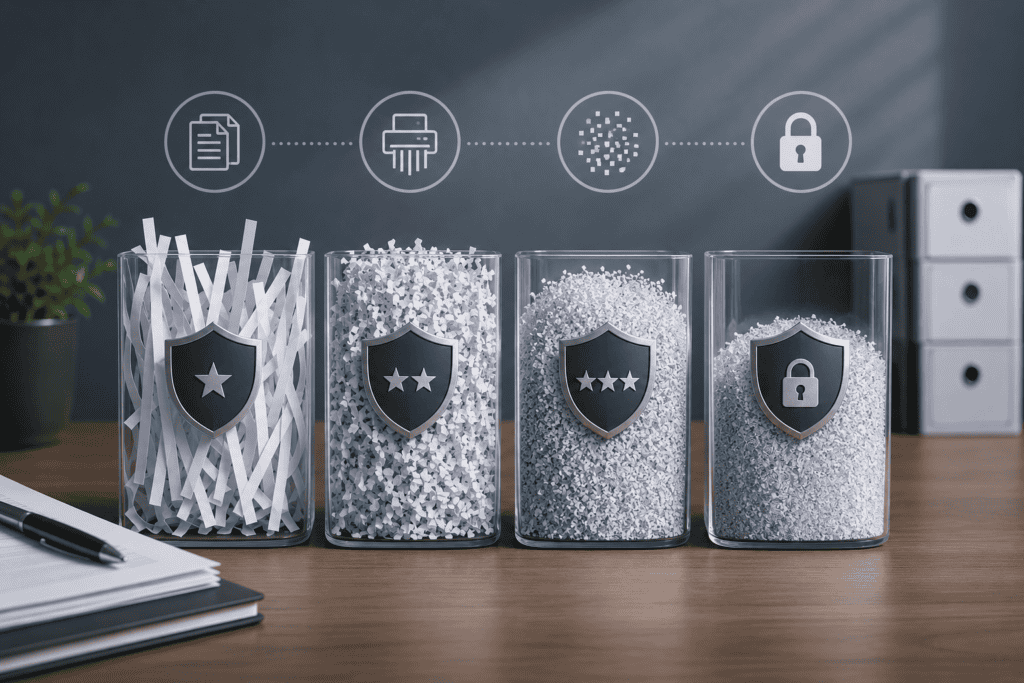
Cross-Cut vs Micro-Cut: Why One Is Not Automatically Better
Many businesses look at cross-cut and micro-cut shredders and immediately focus on which one offers stronger security.
There is more to consider than that, however, as the differences between the two can also affect efficiency, running costs and the amount of paperwork being dealt with every day.
Cross-Cut Shredders
Advantages:
- Faster shredding speeds
- Lower upfront cost
- Good balance of security and productivity
Disadvantages:
- Larger waste particles
- More frequent waste disposal
- Lower security than micro-cut
Micro-Cut Shredders
Advantages:
- Superior data protection
- Smaller waste volume
- Better compliance protection
- Harder document reconstruction
Disadvantages:
- Higher upfront investment
- Slightly slower shredding speeds in some models
However, for businesses processing high document volumes, micro-cut systems often lower total operational costs due to:
- Reduced maintenance
- Fewer breakdowns
- Improved efficiency
- Longer machine lifespan
The Hidden Costs Businesses Overlook
Most purchasing decisions focus only on the price of the shredder itself.
That is usually the wrong metric.
1. Employee Downtime
Small office shredders regularly interrupt workflow:
- Clearing jams
- Emptying bins
- Cooling overheated motors
- Feeding limited sheet volumes
A few minutes spent here and there dealing with paper jams, full bins and overheating may not attract much attention at first, but over time it becomes a costly loss in productivity.
2. Wear, Servicing and Repairs
As document volumes increase throughout the day, consumer-grade shredders can:
- Require more servicing
- Overheat more easily
- Wear out faster under commercial workloads
Unlike consumer models, enterprise machines are built to deal with constant use over extended periods.
3. Long-Term Power Usage
Many businesses focus on the purchase price first, but electricity use can become another cost that builds over time. Lower-quality shredders can use inefficient motors which work harder during heavier workloads or frequent use.
Industrial systems are built for ongoing operation and better suited to handling larger volumes without wasting energy.
4. Compliance Exposure
Using inadequate security levels can create:
- POPIA compliance risks
- Legal liability
- Reputation damage
- Potential data breach exposure
Businesses are always looking for ways to reduce costs, and document security can sometimes become one of the areas where spending is reduced.
However, one data breach can create financial consequences that end up being greater than the investment that was avoided.
Which Shredder Security Level Should Your Business Choose?
P-2 to P-3
Suitable for:
- Small offices
- Low-risk documentation
- Basic internal use
P-4
Recommended for:
- Most South African businesses
- POPIA compliance
- Financial and customer records
P-5
Best for:
- Legal practices handling client records
- Healthcare organisations managing patient information
- Financial organisations working with sensitive data
- High-volume confidential destruction
P-6 to P-7
Reserved for:
- Government
- Military
- Highly classified environments
Why Outsourcing Document Shredding Can Save Businesses Money
Many businesses eventually find that handling document destruction internally becomes more expensive than initially anticipated, especially when all the associated costs start building over time.
Using a professional shredding service removes some of the costs that businesses would normally have to absorb themselves, such as:
- Purchasing shredding equipment
- Ongoing maintenance and servicing costs
- Employee downtime
- Storage risks
- Compliance uncertainty
They also provide:
- Certified destruction
- Secure chain of custody
- Scheduled collections
- Industrial-grade shredding standards
Businesses dealing with larger amounts of paperwork sometimes find that outsourcing document shredding becomes easier to justify financially, while also reducing some of the uncertainty surrounding compliance and document security.
Final Consideration
Choosing a shredder security level is not simply about feeding documents into a machine and destroying them once they are no longer needed.
There are several things connected to that decision, including compliance obligations, reducing risks within the business, productivity, and how efficiently day-to-day work takes place. Long-term costs also form part of the discussion.
The cheaper option can appear attractive at first, especially when businesses are trying to manage spending, but lower upfront pricing does not always translate into lower costs eventually.